Skijoring: The Winter Sport of Horse Racing on Skis
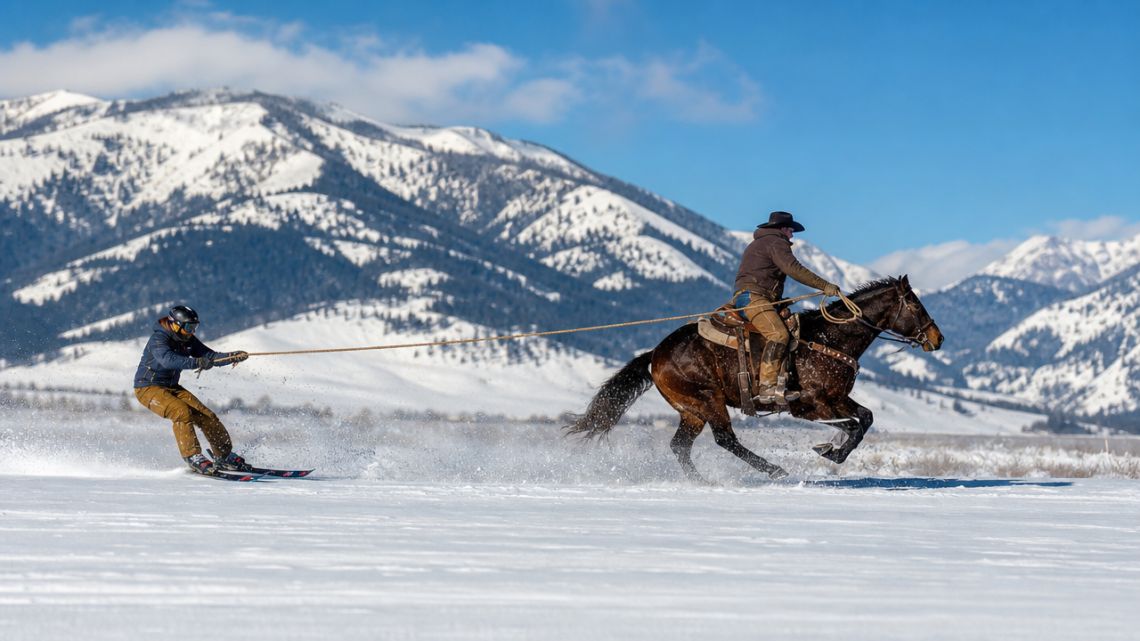
January 15, 2010Few winter sports look as gloriously improbable as skijoring. Picture a skier crouched low and braced for impact, a long towrope in hand, and at the other end of that rope a galloping horse kicking up a wall of snow. The skier is along for the ride, hurtling across a frozen course at speeds that would unsettle most people on solid ground. It is fast, a little wild, and quite unlike anything else on the winter calendar.
The name comes from a Scandinavian word meaning ski driving, and the sport’s roots run deep in the snowy north. In its earliest forms, skijoring was less spectacle than practicality, a way of covering ground when the snow lay thick and a willing animal could do the hard work of hauling a traveler from one place to another. Over time that utilitarian habit grew into competition, and the rope-and-runner pairing became a contest of nerve and skill.
Many Forms of the Sport
While the horse-drawn version draws the biggest crowds, skijoring comes in several flavors. In one popular variant the skier is pulled by one or more dogs, a discipline closely tied to the world of sled-dog sport and prized for endurance over distance. In another, a snowmobile or other vehicle provides the power, trading the unpredictability of an animal for raw mechanical speed. Each form has its own rhythm and its own loyal following.
The horse version remains the headline act, and within it sit two broad styles. In some competitions a rider sits astride the horse and tows the skier behind, while in others the skier holds the reins and drives the animal directly. Both demand trust between the people involved and a great deal of composure when the snow starts flying.
Town Events and the Art of Staying Upright
Across parts of the American West and the European Alps, skijoring has become a beloved fixture of small-town winter festivals. Streets and fields are transformed into temporary courses, complete with jumps, gates, and rings for the skier to spear with a baton as they pass. Crowds bundle up along the route, the atmosphere is festive, and the whole affair has the feel of a community celebration as much as a race.
What none of this conveys until you watch it closely is how hard the skiing actually is. Staying upright behind a horse at full gallop asks for constant balance adjustments, strong legs, and the ability to absorb sudden surges as the animal accelerates. Jumps arrive quickly, the towrope tugs without warning, and a moment of hesitation can send the skier tumbling into the powder. The best competitors make it look effortless, which is the surest sign of how much practice it takes.
That blend of danger, skill, and spectacle is exactly why skijoring endures as one of winter’s great oddities. It rewards courage, it delights spectators, and it keeps an old Scandinavian tradition very much alive.