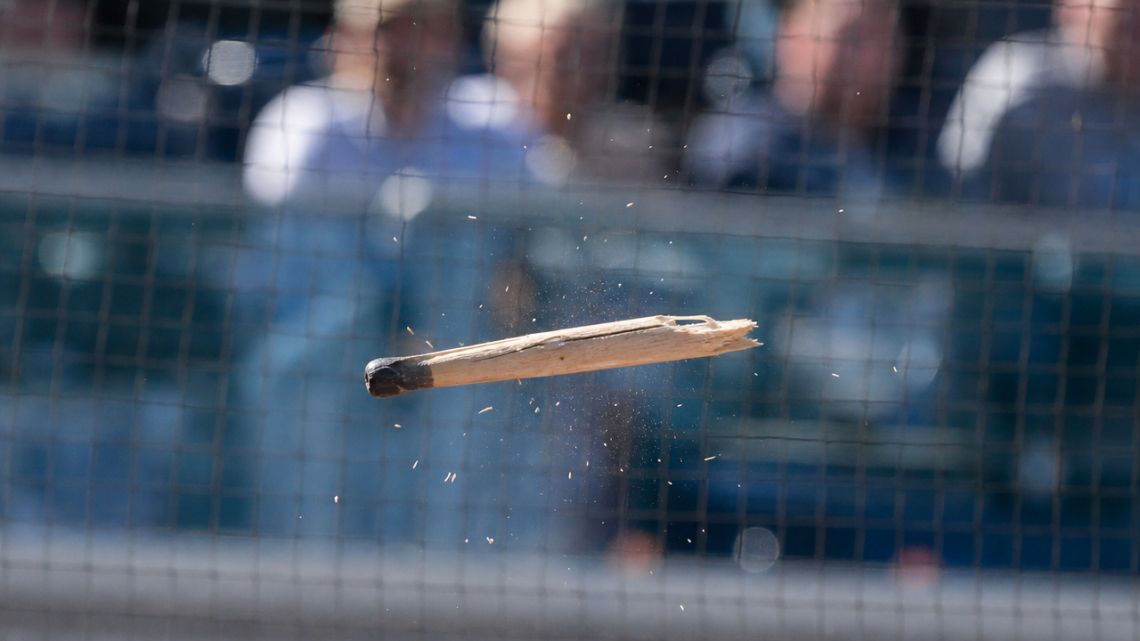
Spring Training Dangers: When a Bat Flies Into the Crowd
February 2, 2010For most of baseball’s history, the great spectator hazard was the foul ball, a hard sphere screaming into the seats faster than any fan could react. In recent decades a second danger has crept into the conversation, and it is arguably stranger and more unsettling: the bat itself. Whole bats and jagged fragments of bats now reach the stands often enough that ballparks have changed their architecture to deal with it. Spring training, with its cozy stadiums and fans pressed close to the action, is where the risk feels most immediate.
Why Bats End Up in the Stands
Two separate problems combine to launch wood toward the crowd. The first is the swing itself. A check-swing, where a batter tries to hold up at the last instant, puts awkward forces on the hands, and a bat can simply slip free and helicopter into fair territory or the seats. Sweaty grips, pine tar gone wrong, and the sheer violence of a major-league swing all play a part. A bat that leaves a hitter’s hands is traveling with real speed and almost no warning.
The second problem is breakage, and here the type of wood matters a great deal. Maple bats, which became hugely popular among hitters, have a reputation for shattering rather than cracking. Where an older ash bat might splinter and hang together, a maple bat can break into hard, sharp shards that fly in unpredictable directions. The barrel can spear off the handle and travel a surprising distance. It is not the gentle crack of folklore; it is a sudden explosion of pointed debris.
The Move Toward More Netting
The response has been visible to anyone who has been to a game lately. Protective netting, once confined to the area directly behind home plate, has steadily expanded down both baselines. The reasoning is straightforward: the seats closest to the field offer the least reaction time, and they are exactly where a slipped or shattered bat is most likely to land. Extending the net is a blunt but effective way to put a barrier between fragile spectators and flying wood.
The trade-offs are real, and fans debate them with some passion. Netting can dull the sense of being right on top of the game, and a few purists grumble about watching through a mesh screen. Against that stands the simple fact that a sharp piece of maple traveling at speed does not care whether a fan was paying attention. The general direction of travel has favored more protection rather than less, with parks tending toward:
- Netting extended well beyond home plate, often to the far ends of the dugouts and beyond
- Greater awareness in close, intimate venues where fans sit unusually near the field
- An accepted trade of a slightly obstructed view for a meaningful reduction in risk
What makes the flying bat such a peculiar danger is how unpredictable it is. A foul ball at least follows the logic of the swing. A bat can come loose on a checked swing no one expected, or detonate into pieces on solid contact, scattering wood in directions no fan could anticipate. That randomness is precisely why the netting keeps creeping outward, quietly reshaping the experience of sitting close to the game.