Calcio Storico: Florence’s Brutal Renaissance Football
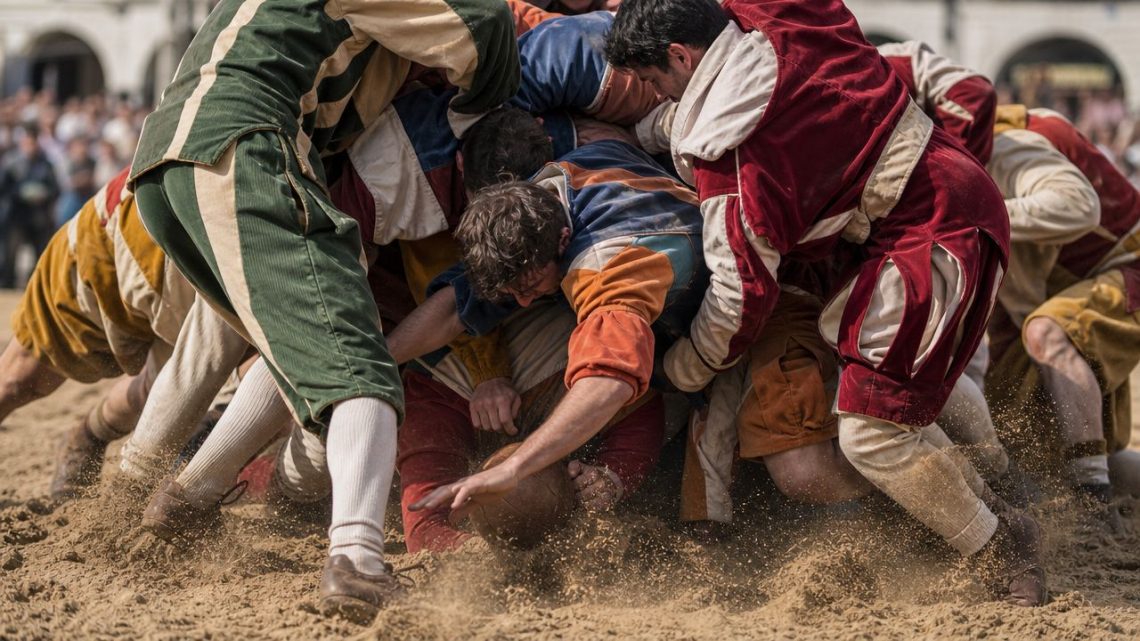
September 3, 2026In a sand-covered square in the heart of Florence, men in Renaissance costume gather each summer to play a game that looks less like football and more like a controlled riot. Calcio storico fiorentino, sometimes called calcio in costume, is a brutal ancestor of modern ball sports, preserved almost as a piece of living history. It blends elements of football, rugby and bare-knuckle brawling into a single ferocious contest, and it has been played in roughly its current form since the sixteenth century.
The setting is part of the theater. Piazza Santa Croce, ringed by handsome facades and a famous basilica, is covered in a deep layer of sand to create the pitch. Players parade through the streets beforehand in period dress, flanked by flag-throwers and drummers, before stripping down to compete. The pageantry is genuine and elaborate, but it is only the prelude to something considerably rougher than the costumes suggest.
Four Teams, One City
The competition is rooted in the city’s old quarters, with teams representing the historic districts of Florence. Each side fields a large squad, and the goal is deceptively simple: get the ball into the opponent’s net, which stretches the full width of each end of the field. Scoring is called a caccia, and a successful one is worth a point, though the rules contain a famous wrinkle. A team that overshoots the net and misses the goal hands a half-point to the opposition, which discourages reckless long-range attempts and rewards patience even amid the chaos.
Patience, however, is in short supply once play begins. The matches run for a fixed stretch of time without the frequent stoppages that tame modern sports. Wrestling, tackling and outright fistfights between players are part of the fabric of the game rather than fouls to be punished. The physical attrition is enormous, and the strategy often involves neutralizing opponents as much as advancing the ball. There are referees and a small set of restrictions, but the contest remains startlingly violent by contemporary standards.
Ferocity by Tradition
That ferocity is not an accident or a modern embellishment. The game was always a test of strength and civic pride, a way for districts to settle rivalries in front of the whole city. Florentine nobility and even future popes are said to have taken part in earlier centuries, lending the rough sport a surprising prestige. Today the players are local athletes who train hard and treat the bruises as a badge of belonging to their quarter.
The combination of beauty and brutality is what makes calcio storico so memorable. Few spectacles pair Renaissance costume and choreographed processions with the raw spectacle of dozens of men grappling in the sand. The injuries, predictably, can be severe, which places the game in the company of other sports where the physical toll is part of the legend, a theme explored in this account of strange but true sporting injuries. For Florence, the danger is simply the price of keeping a centuries-old tradition alive in its original, unvarnished form.