Kyle Field and the Legend of the 12th Man
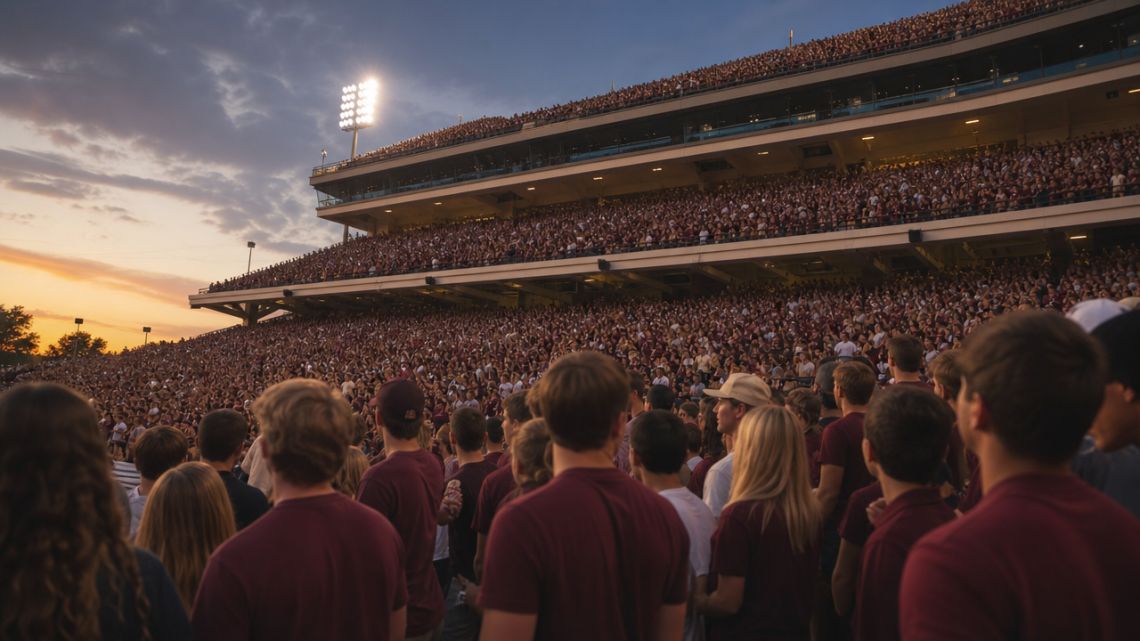
January 1, 2010College football is full of traditions that outsiders find faintly baffling, but Texas A&M’s may be the most physically demanding of them all. At Kyle Field, the student body does not sit down. For the entire game, through every drive and every timeout, the students remain on their feet, ready in spirit to step onto the field if called. They are the 12th Man, and standing for hours on end is one of the strangest customs in American sport.
A Player Called From the Stands
The tradition traces back to the early 1920s and a story that has been retold so many times it has hardened into legend. A student named E. King Gill was watching a hard-fought game in which injuries had thinned the Aggie ranks. As the available players dwindled, Gill was reportedly summoned from the stands, put on a uniform, and stood ready on the sideline in case the team needed one more body.
As the story is usually told, he never actually entered the game. But he was there, willing to play, the lone fan who had crossed the line from spectator to potential participant. That image of a student prepared to serve became the seed of everything that followed. A team that had run desperately short of men had found, in the stands, one more who was ready.
Standing Ready, Game After Game
From that single moment grew a tradition built entirely around readiness. The 12th Man came to mean the whole student section, an entire crowd symbolically prepared to take the field. Standing for the full game is the physical expression of that idea. The students stay on their feet not because the rules demand it but because sitting down would feel like breaking faith with the story they have inherited.
The customs that surround it reinforce the theme:
- Students standing for the entire game as a sign they are always ready to play
- The 12th Man understood as the unified voice and energy of the crowd
- Generations of students treating the tradition as a duty passed down rather than a choice
What makes Kyle Field so distinctive is the scale of the commitment. Plenty of fan bases are loud, and plenty pride themselves on never leaving early. But the deliberate, game-long act of standing turns ordinary spectating into something closer to a vow. It is one thing to cheer; it is another to remain on your feet for three or four hours because a student did so a century ago.
The stadium itself has become bound up with the legend. Kyle Field is one of the largest venues in the sport, and when it is packed with students who refuse to sit, the effect can be genuinely overwhelming for visiting teams. The noise is part of it, but so is the visual, an entire section that simply will not relax until the final whistle.
Seen from the outside, it can look like stubbornness, even discomfort dressed up as devotion. Seen from the inside, it is a way of keeping a single afternoon from the 1920s alive in the present. The 12th Man is strange precisely because it asks so much of people who will probably never set foot on the field. That, in the end, is the point.