The 1995 Indy 500 Crash: Stan Fox’s 200 MPH Survival
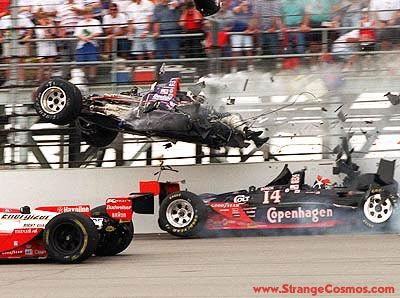
December 9, 2013Some racing crashes are remembered for their tragedy. Others are remembered for the sheer disbelief they leave behind, the kind of wreck that looks unsurvivable and yet, somehow, isn’t. The accident that ended Stan Fox’s day at the start of the 1995 Indianapolis 500 belongs firmly in that second category. It happened in the opening lap, at the kind of speed Indy cars carry into the first corner, and it remains one of the most violent-looking incidents motor racing has ever broadcast to a live audience.
The footage is hard to forget. Fox’s car was caught up in contact early in the race, and what followed was a spectacular disintegration. The open-wheel, open-cockpit machine came apart around him in pieces, sliding and tumbling across the track while debris scattered in every direction. The defining image, the one that made spectators gasp, was the driver himself, fully exposed, his legs visible where the front of the car had been torn away. For a sport that already traded in danger, this was danger laid bare.
Why It Looked So Bad
The shock of the crash came down to a simple, uncomfortable truth about the cars of that era. An open-cockpit racer offers almost nothing above the driver’s shoulders and very little ahead of the feet. When the bodywork peels away, there is no cabin to hide the human consequences. Viewers were not watching a sealed capsule skid to a halt; they were watching a person sitting in the open as the machinery around him broke apart at enormous speed.
That exposure is what separated this wreck from a routine spin. It was not the spectacle of fire or a wall impact that lingered in memory, but the visibility of the driver, the unmistakable sense that there was nothing between him and the disaster unfolding around him.
Survival and the Long Road of Safety
Against the odds suggested by the images, Fox survived. He sustained serious injuries, and his recovery was a long one, but he lived through a crash that countless onlookers assumed no one could walk away from. That outcome is part of why the incident endures as a talking point rather than a tragedy.
It also fed a conversation that motor racing has never really stopped having. Open-cockpit cars expose drivers in ways closed designs do not, and accidents like this one kept that vulnerability in plain sight. Over the years that followed, the broader project of making single-seater racing safer pressed forward on several fronts, including:
- Stronger survival cells and improved energy-absorbing structures
- Better head and neck protection for the exposed cockpit
- Continued debate over how much to enclose the driver without losing the sport’s character
None of this happened because of a single crash, and it would be wrong to draw a straight line from one accident to every later innovation. But incidents that put driver exposure front and center have a way of sharpening the argument. The 1995 wreck did exactly that. It was a reminder, delivered in the most graphic terms possible, that the thing making these cars so thrilling to watch is also the thing that leaves their drivers with so little to hide behind.